NATO DIANA Innovator 2025

A continuously improving CV capability across your sensor network.

Counter-UAS, ISR, and tactical computer vision that adapts to the operational environment, not the other way around. Models train where the sensor data is generated, improve across every site in the network, and remain under national control end to end. Detections flow into ATAK and standard C2 systems out of the box.

Loading

The Problem

A capability gap, not a tooling gap.

Armed forces investing in AI for CUAS, ISR, autonomous systems face three problems at once. Each one defeats conventional MLOps pipelines.

Detection model performance degrading over time as conditions in the field change

Models go stale.

Today's CV models for CUAS, ISR, and targeting are typically trained centrally, deployed once, and updated infrequently. They degrade as seasons, weather, adversary tactics, and operational environments shift. The data that would make them robust cannot be centralised. It is too sensitive, too large, or generated where no reliable uplink exists.

Terabytes of sensor data accumulating unused at the edge while central training data remains scarce

Local data overload. Central data scarcity.

Each site generates far more sensor data than can be reviewed or annotated. Terabytes of range and drone footage accumulate unused. Centrally, the opposite: a chronic shortage of the operational data that would make models robust. The infrastructure to close this gap, by selecting the right frames locally, training on them locally, and sharing improvements without sharing data, does not exist in standard MLOps toolchains.

Sensor vendor AI lock-in: closed, vendor-controlled detection models on heterogeneous sensors

Sensor-vendor lock-in.

The common workaround is to use the models supplied by the sensor manufacturer. These are trained on the vendor's data, optimised for the vendor's hardware, and updated on the vendor's cycle. This recreates at the AI layer the dependency that armed forces have worked to escape at the hardware and data layer. It also makes it difficult to fuse detections across sensors from different manufacturers into a coherent picture.

The Network

Three components. One capability.

The Tactical Computer Vision Network is built from three components working as a single capability. Each is meaningful on its own; together they close the loop from sensor to model and back.

The underlying principle is simple: instead of moving data to the model, the model is sent to the data. Each site deploys models for real-time inference, selects data intelligently, and trains locally. Only encrypted weight updates are contributed back to the network. Every operational site becomes a source of model improvement, not a data sink.

Control Plane Scaleout Edge
Model Registry
Federated Training
Observability
Audit Trail
Models
Updates
Vision Ground Nodes At each site

Forward base

Inference
Local data

Test range

Train locally
Local data

Command vehicle

Annotate
Local data
Models
Detections
Edge AI Companions On platforms
Drones
Vehicles
Embedded
Raw data never leaves its tier
1 Vision Ground Node

The forward ML workbench

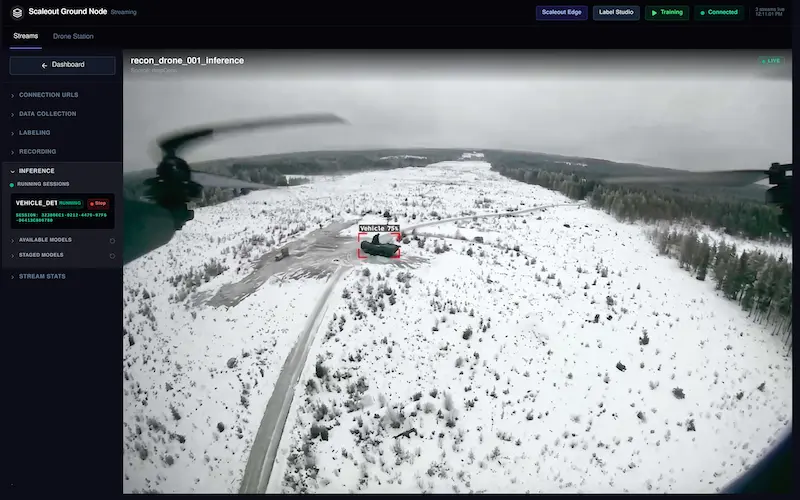
GPU-accelerated edge stations deployed at bases, ranges, command vehicles, and forward positions. Each node runs the full CV lifecycle on-site: live inference, active data selection, annotation, local fine-tuning, and federated training. Designed to be operated by personnel without deep ML expertise.

2 Edge AI Companion

The on-platform endpoint

A lightweight on-platform compute module that runs validated models directly on drones, vehicles, and embedded sensors. Operates autonomously when disconnected. Synchronises detections, telemetry, and updated models with the nearest Ground Node when a link is available.

3 Scaleout Edge

The sovereign control plane

The platform that ties the network together. Hosts the model registry, federated training engine, fleet observability, and the immutable audit trail. Deployed in customer infrastructure. Air-gap capable. No external SaaS dependencies.

The Loop

A continuous improvement cycle across every site.

A detection that exposes a gap in the model at one site contributes to a better model at every site. The loop runs continuously, and during exercises it can close in a single day.

Annotation quality is the single largest determinant of model performance. The network is designed to minimise the human burden at this step, through active learning, pre-annotation, and locally-resident workflows, while maximising the impact of every labelled frame.

The Continuous Loop
At the edge
Control plane
1Capture
2Detect drift
3Select
4Annotate
5Fine-tune
6Federate
7Redeploy
Cycle continues
1 Capture

Edge AI Companions run real-time detection on drones and embedded sensors. Ground Nodes ingest live video from cameras, EO/IR payloads, and UxV downlinks. Detections cached locally, synchronised when connectivity allows.

2 Detect drift

The observability pipeline tracks confidence distributions, class frequencies, and drift indicators across the fleet. A new drone type, unusual lighting, or an unfamiliar environment surfaces as a measurable shift.

3 Select

Active learning reduces terabytes of raw video to hundreds of high-value frames per campaign. Uncertainty sampling finds where the model is least confident; diversity sampling finds scenes that differ from what it has seen.

4 Annotate

Selected frames are labelled on the Ground Node through a browser-based interface. Pre-annotation with current model predictions accelerates the work; annotators correct rather than label from scratch. Raw imagery never leaves the site.

5 Fine-tune

Models are fine-tuned on the curated local dataset. Before promotion, the updated model runs alongside the current production model on the same live feed for quantitative comparison.

6 Federate

When two or more Ground Nodes are deployed, model updates aggregate into a shared global model through the Scaleout Edge federated learning engine. The global model learns from every site (arctic, coastal, urban, desert) without any site sharing raw data.

7 Redeploy

The improved model is validated, signed, and staged from the control plane back to Ground Nodes and Edge AI Companions across the network. During intensive exercises, this cycle can run daily.

Continuous

Every detection that exposes a gap contributes to a better model across the entire network.

Vendor-neutral ingestion One view out
Sensor fan-in diagram: multiple heterogeneous sensor vendors feeding into the network, with a unified output to C2 systems.

Many vendors in. One operational view out. Detections from heterogeneous sensors converge into a single feed for the operator's common operating picture.

C2 & Sensor Integration

Augments your C2. Stays neutral on your sensors.

The network is designed to extend existing command and control infrastructure, not replace it, and to keep model ownership with the customer rather than the sensor manufacturer.

TAK and C2 integration

Ground Nodes can act as an AI hub for ATAK and other TAK clients through the OpenTakServer integration, forwarding AI-derived detections and tracks into the tactical picture. Standard interfaces (REST, gRPC, MQTT, RTSP) support integration with other C2 systems.

Sensor-agnostic ingestion

Cameras, EO/IR payloads, and UxV downlinks from any manufacturer are ingested through standard streaming protocols. Detections from sensors of different makes converge into one coherent operational picture, not a set of disconnected vendor silos.

Models the customer owns

Models can be developed in-house, commissioned, procured from specialist SMEs, or sourced from open repositories. The platform provides operationalisation, governance, and continuous improvement; the customer retains full control of model strategy. Reference models for CUAS (ground-to-air) and ISR (air-to-ground) ship with the platform to avoid a cold start.

Resilience

Built for environments where the link is not guaranteed.

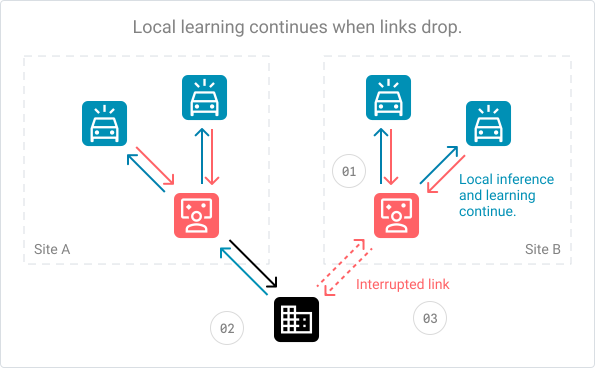
The capability does not depend on a working uplink. Each Ground Node operates in three connectivity modes, and changing modes does not change what the node can do locally. Edge AI Companions on drones and vehicles follow the same pattern at the platform level.

Connected

Continuous link

Continuous link to the control plane. Full federated training, model staging, fleet observability, and audit trail.

Intermittent

Scheduled sync

Periodic connectivity through scheduled sync windows or tactical links. The node operates autonomously between syncs, queuing model updates and telemetry for transmission when the link returns.

Disconnected

Standalone operation

No connectivity. The node runs inference, captures data, and trains locally. Nothing is lost; only the cross-site federated learning benefit is deferred until reconnection.

Data Sovereignty

Sovereignty by architecture, not by policy.

Designed for environments where raw data physically cannot leave the site, and where every model decision must be auditable.

Raw data stays at the site

Raw sensor data never leaves the Ground Node. Only model weight updates and telemetry are transmitted during federated training.

Customer infrastructure, air-gap capable

The control plane runs in customer infrastructure. No public cloud dependency. No external SaaS dependencies. Can be deployed entirely within an air-gapped perimeter.

Cryptographic model integrity

Models are cryptographically signed before distribution. Edge nodes validate signatures before loading. A tampered or unauthorised model is rejected.

Immutable audit trail

Every model version is recorded with full lineage: Compute Package hash, participating clients, aggregation events. Queryable and exportable as evidence bundles.

From Pilot to Capability

A staged programme. No commitment to scale until value is demonstrated.

The programme follows a staged approach with decision points at each step. It is designed to go from T&E to production capability in approximately 12 months. There is no commitment to scale until value has been demonstrated.

The operating model separates three roles: Scaleout (platform and ML engineering), an operating partner (annotation, on-site operations), and the customer (domain expertise, model strategy, eventual ownership). By the later stages, the customer's own ML team owns model strategy and Scaleout's role narrows to platform support. The platform provider is not in the critical path of daily operations.

On the operator side, the system is designed to be run by personnel without deep ML expertise. Scaleout's Forward Deployed Engineering provides direct in-team support through the early stages, with deliberate handover to the customer's own engineers as the programme matures.

Programme Stages Decision point at each step
1

Lab Workbench

~2 months

End-to-end development environment using platform reference models. Demonstrates inference, active data selection, annotation, and local training. Performance benchmarks established. Knowledge transfer to customer team.

2

Field Validation

~2 months

Ground Node deployed to live environments: ranges, exercises, UxV test flights. Real-world inference and data acquisition validated. Reference models fine-tuned to local conditions. Graceful degradation under network stress demonstrated.

3

Pilot & Optimisation

~6 months

Pilot users invited. Domain-specific model tuning (arctic, CUAS, maritime, urban). Systematic improvement cycle operational. Sovereign Fleet Learning validated across multiple nodes.

4

Scale (optional)

~2 months

Expand to 5–10+ ground nodes across sites. Fleet learning across the full network. Data collection campaigns. Operating partner fully operational.

5

Production

Ongoing

Continuous operations with production SLA. Embedded deployment in fielded systems. Onboard additional units and partners.

A natural starting point: a 60-day Stage 1 engagement to demonstrate the full workflow on real data.

The Components, In Detail

What you actually deploy.

Each component is meaningful on its own, and gets more useful as the others join.

Vision Ground Node, semi-rugged unit installed in a vehicle

Vision Ground Node

The forward ML workbench

GPU-accelerated edge station that brings the full computer vision lifecycle to the site where the sensors are. Inference, active data selection, annotation, local fine-tuning, federated training, all on-site. Available in COTS and semi-rugged reference configurations.

  • Live sensor ingestion via RTSP, RTMP
  • NVIDIA RTX PRO 6000 / 4500 Blackwell
  • Browser-based annotation on-node
  • Federated training across sites
Learn more about the Ground Node
Edge AI Companion, NVIDIA Jetson Orin mounted on a drone

Edge AI Companion

The on-platform endpoint

A lightweight, embeddable AI compute module that extends the Scaleout Edge pipeline to the platform itself: a drone, an unmanned ground vehicle, a manned vehicle. Designed for system builders to integrate alongside flight controllers, sensor payloads, and comms.

  • On-device inference, fully autonomous
  • NVIDIA Jetson Orin or RPi 5 + Hailo
  • Local sightings DB, syncs with ground node
  • Model staging from control plane
Read the Edge AI Companion Brief
Scaleout Edge, control plane UI

Scaleout Edge

The sovereign control plane

The platform that ties the network together. Model registry, federated training engine, fleet observability, and the immutable audit trail. Deployed in customer infrastructure. Connects upward to existing MLOps tooling and downward to every Ground Node and Edge AI Companion in the fleet.

  • Model registry with full lineage
  • Federated learning orchestration
  • Air-gap capable, no SaaS dependencies
  • MLflow, Kubeflow, SageMaker interop
See the platform page

Start with a Stage 1 engagement.

A 60-day Stage 1 establishes the lab workbench, demonstrates the full workflow on real data, and jointly defines the path to field validation. No commitment to scale until value has been demonstrated.